Plasmon-Enhanced Exciton Re-Localization in Quasi-2D Perovskites: Low-Threshold Room-Temperature Plasmonic Lasing
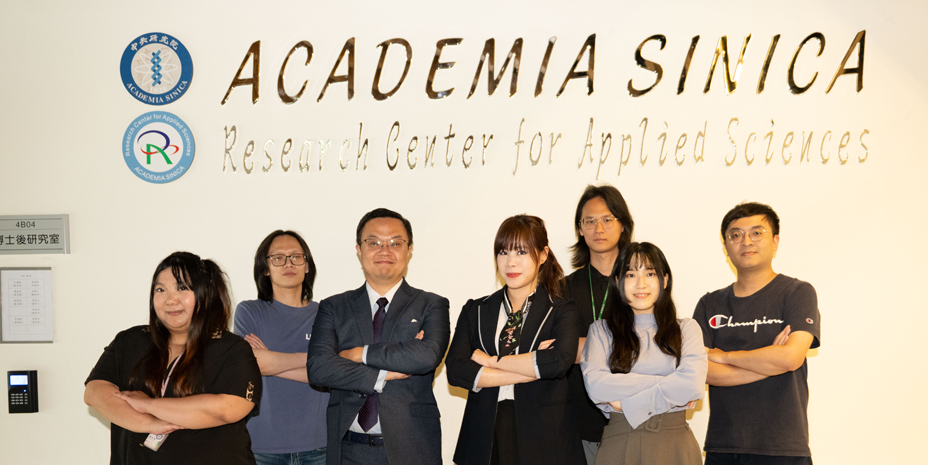
Photography by Wesley Chen In the center are Prof. Yu-Jung Lu (right) and Prof. Chu-Chen Chueh (left). RCAS team members from left to right: Jia-Wern Chen, Xing-Hao Lee, Yen-Yu Wang, Linchyn Yuan, and Tzu-Yu Peng.
Summary of Achievement
A research team led by RCAS researcher Prof. Yu-Jung Lu recently published their findings in Science Advances. Working in collaboration with Prof. Chu-Chen Chueh from National Taiwan University (NTU), Prof. Lu and her collaborators demonstrated room-temperature plasmonic lasing by integrating quasi-two-dimensional (quasi-2D) perovskites with high-Q plasmonic nanostructures. Room-temperature nanolasers are crucial for advancing optical communication and photonic quantum technologies due to their capability to generate coherent light at a subwavelength scale. However, their development is constrained by challenges such as insufficient gain, material instability, and high lasing thresholds. By integrating quasi-2D perovskites with high-Q plasmonic nanostructures, we demonstrate a stable, wavelength-tunable, single-mode laser operating at room temperature. This device leverages a unique exciton relocalization effect in quasi-2D Ruddlesden-Popper perovskites with additive, substantially enhancing optical gain and improving stability. When coupled with a waveguide-hybridized surface lattice resonance mode (SLR), the enhanced light-matter interaction facilitates single-mode lasing with a notably low threshold. Additionally, the device achieves robust lasing performance with extended operational stability. These results provide a scalable, low-cost, and energy-efficient platform for nanolasing, with potential applications in next-generation photonic technologies, including LiDAR, sensing, optical communication, and computation.
The research was published in Science Advances on May 7, 2025. The first author is Yen-Yu Wang, a Ph.D. student in the TIGP-Nano program at Academia Sinica. Xing-Hao Lee is listed as a co-first author and is currently affiliated with TSMC. The research was supported by the Academia Sinica, the National Science and Technology Council, and NTU-AS Innovative Joint Program.