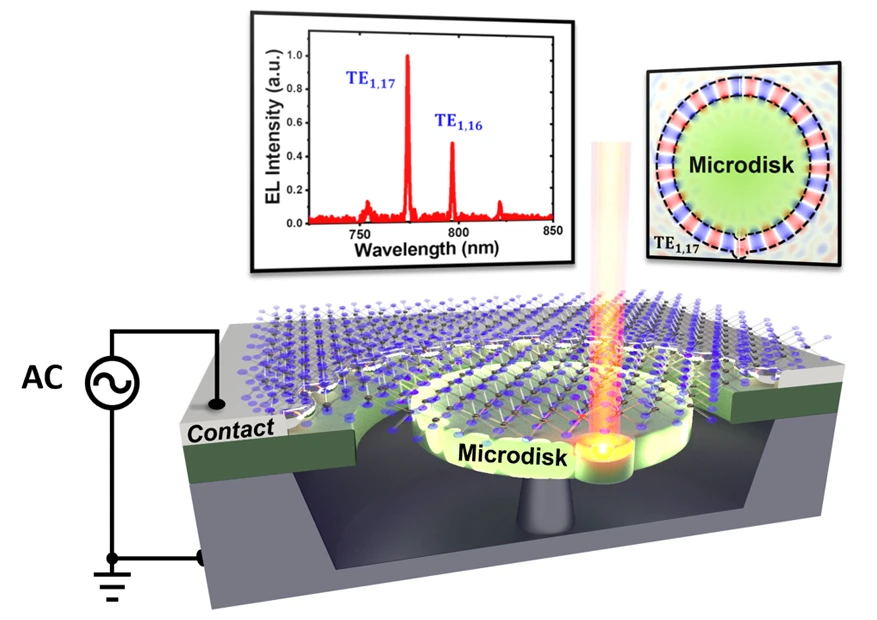
Two-dimensional (2D) materials have sparked great interest in science and engineering in recent years. A particularly important family, called 2D transition-metal dichalcogenides (TMDCs), are only sub-nm thick yet exhibit remarkable optical properties. Because of their ability to interact strongly with light at nanoscale, 2D TMDCs are considered key materials for developing the next generation of ultracompact and energy-efficient optoelectronic devices.
In earlier studies, scientists have already succeeded in demonstrating lasers based on 2D TMDCs, but these were driven only by external light sources. For real applications, however, lasers must be powered by electrical currents, which makes integration into chips and communication systems possible. Achieving an electrically-driven 2D material laser has therefore been one of the most critical challenges in the field.
Our research team has now overcome this barrier by realizing the first electrically driven 2D TMDC microcavity laser. The device integrates a monolayer of tungsten diselenide (WSe2) with a microdisk optical cavity. Under alternating-current (AC) electrical excitation, the system produces laser emission at room temperature. To conclusively verify lasing, we examined the output characteristics—including intensity scaling, spectral linewidth narrowing, and emission coherence—all of which confirm the lasing action.
This breakthrough represents a major milestone: it transitions 2D materials from “optically pumped lasers only” to practical, electrically driven laser sources. The result not only highlights the extraordinary potential of 2D materials but also paves the way for future applications in silicon photonics, quantum light generation, and high-speed optical communication technologies.